Popular Searches
Preface
Conventional pulverizing system analysis generally adopts dual-constraint models: grinding capacity and drying capacity. This is a simplified calculation model for the equipment-selection phase. Based on field operation experience and separator retrofitting practices of ZGM/HP-series medium-speed coal mills, the actual capacity of a complete pulverizing system is constrained by three independent bottlenecks: drying capacity, grinding capacity and classification capacity.
The final pulverizing-system capacity is determined by the minimum value among the three.
Core Viewpoint: Grinding only produces mixed coarse-and-fine pulverized coal; drying guarantees the flowability of pulverized coal; the separator screens qualified pulverized coal under specified fineness requirements. Its classification performance and circulating re-grind level can independently become a capacity bottleneck. Many field efficiency-improvement retrofits fail to deliver expected results precisely because the constraint of classification capacity has been overlooked.
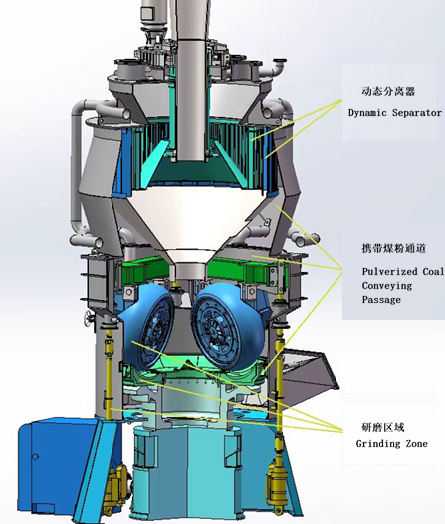
I. Definition and Constraint Mechanism of the Three Capacities
1. Drying Capacity (Thermal Bottleneck)
Definition: Under given primary-air flow rate and hot-air temperature, the maximum raw-coal processing capacity that can remove surface moisture of raw coal per unit time to prevent pulverized-coal caking, mill blockage and ensure conveyability.
Constraining Factors: primary-air flow rate, hot-air temperature, surface moisture of raw coal, internal mill ventilation flow field.
Characteristic Phenomena: Rising raw-coal moisture leads to increased mill differential pressure, damp pulverized coal and abnormally large refuse-coal output. Coal feed rate has to be reduced even before the mill reaches its rated loading force.
Boundary: Upper limit determined by heat balance; strongly correlated with coal moisture, with no direct link to pulverized-coal fineness.
2. Grinding Capacity (Mechanical Bottleneck)
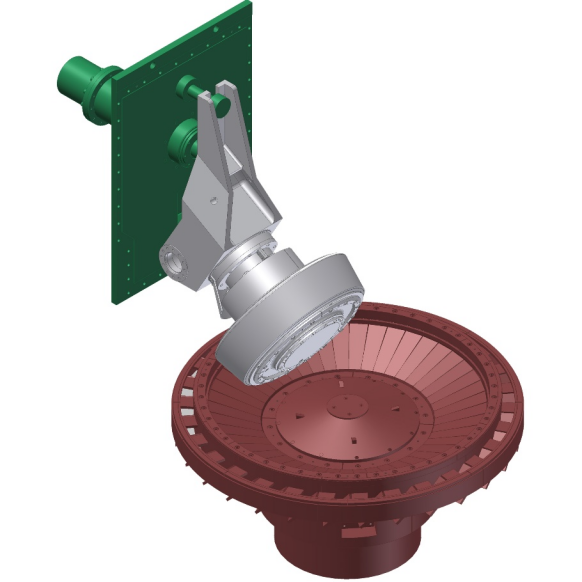
Definition: Under set loading force and mill-table rotational speed, the maximum raw-coal processing capacity of the grinding assembly (mill rollers and mill table) for crushing raw coal into mixed coarse-and-fine pulverized coal per unit time.
Constraining Factors: wear condition of roller and liner plates, loading oil pressure, mill-table rotational speed, Hardgrove Grindability Index (HGI), effective grinding volume inside the mill.
Characteristic Phenomena: For hard-to-grind coal (low HGI), mill current and loading pressure reach rated values. Increased coal feed results in insufficient grinding and higher coarse-fraction content.
Key Misconception: Grinding capacity ≠ qualified pulverized-coal output. Grinding output contains large quantities of coarse re-grind material and cannot be directly equated to boiler-usable pulverized coal.
3. Classification Capacity (Classification Bottleneck, Key Focus)
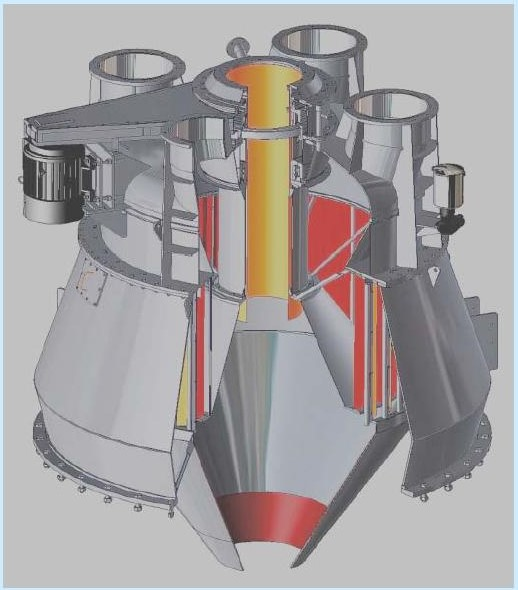
Definition: Subject to boiler-required pulverized-coal fineness (R90/R200), the separator uses airflow classification to produce maximum qualified pulverized-coal output per unit time. Its core indicator is controllable circulating load (re-grind ratio).
Constraining Factors:
1.Separator type: static separator / dynamic rotary separator
2.Flow-field uniformity, blade geometry, rotating-blade speed
3.Internal mill ventilation rate, inlet-outlet differential pressure
Core Mechanism Formula: \(G_{raw}=G_{out}\times(1+K)\)
\(G_{raw}\): mill coal feed rate; \(G_{out}\): qualified pulverized-coal finished output; K: circulating-load coefficient.
Under identical coal-feed conditions: stricter fineness requirement → reduced cut-off particle size → higher re-grind rate → increased K.
Coarse re-grind material accumulating on the mill table occupies grinding space and raises ventilation resistance, directly suppressing system capacity.
Typical Characteristic Phenomenon: Coal is easy-to-grind, hot-air supply is sufficient and loading force has remaining margin. To satisfy low-NOₓ combustion requirements, pulverized-coal fineness is tightened by raising dynamic-separator rotating speed. Mill differential pressure rises rapidly and coal feed must be cut back. In this scenario, both drying and grinding capacities have surplus, and classification capacity becomes the system bottleneck.
II. Typical Operating-Condition
Differentiation for Three Bottlenecks
(Field reference for ZGM / HP coal mills)
Constraining Bottleneck | Core Operating Condition Features | Adjustment Response |
Drying capacity limited | High inherent & surface moisture in raw coal during rainy seasons; low hot air temperature; damp pulverized coal inside mill | System capacity rises notably after increasing hot air temperature and primary air flow |
Grinding capacity limited | Hard to grind coal with low HGI; severely worn liner plates; insufficient loading pressure | Capacity improves significantly after raising loading oil pressure or repairing mill rollers / liners |
Classification capacity limited | Acceptable coal quality, sufficient air temperature & flow, loading below rated limit; pursuit of fine pulverized coal; distorted separator flow field | System capacity is effectively unlocked by relaxing pulverized coal fineness or optimizing separator blade / rotating blade geometry |
III. Why Do Conventional Theories Adopt Only the Dual-Capacity Model?
1. Simplification for Equipment-Selection Calculation: In thermal calculation and tender-oriented equipment selection, pulverized-coal fineness requirements are assumed loose and circulating load relatively stable. Separator influences are incorporated into capacity correction coefficients rather than treated as an independent bottleneck.
2.Operating conditions in the era of legacy static separators: Early units adopted lenient pulverized-coal fineness standards with small fluctuation in re-grind ratio, so classification bottlenecks seldom surfaced.
3.Operational cognitive bias: Most operation and maintenance personnel regard separators merely as “fineness-adjustment tools”, failing to recognize that fineness adjustment is essentially a trade-off between capacity and fineness.
IV. Re-engineering Pulverizing-System Efficiency-Improvement Retrofit Philosophy via the Triple-Bottleneck Theory
Approach 1: Identify the Dominant System Bottleneck
(Pre-retrofit Diagnostic Step)
Prioritize variable-condition trial tests:
1. Stabilize coal quality, gradually raise hot-air temperature and primary-air flow, and observe capacity variation → identify whether drying is the bottleneck.
2. Increase mill loading pressure and monitor capacity and refuse-coal output → identify whether grinding is the bottleneck.
3. Keep coal quality, air flow and loading unchanged; adjust separator rotating speed / baffle position, and monitor capacity, fineness and mill differential pressure → identify whether classification is the bottleneck.
If tests confirm classification-capacity limitation, simply replacing mill rollers or boosting loading pressure will yield marginal benefits.
Approach 2: Retrofit Measures Targeting Different Bottlenecks
(1) Drying-Bottleneck Optimization
1.Optimize hot-air ductwork to reduce resistance; raise hot-air temperature; properly match primary-air flow rate.
2.Optimize pre-dehydration of raw coal to control incoming-mill surface moisture.
3.Improve internal-mill ventilation flow field to avoid local coal accumulation.
(2) Grinding-Bottleneck Optimization
1.Upgrade wear-resistant material for mill rollers and liners; correct roller-sleeve clearances.
2.Retrofit spring-loading systems to hydraulic loading to expand adjustable loading-pressure range.
3.Optimize mill-table rotational speed to match coal-type grindability.
(3) Classification-Capacity Bottleneck Optimization (Easily Overlooked)
1.Retrofit static separators to dynamic rotary separators: broaden fineness adjustment range and lower circulating load under identical fineness targets.
2.Optimize internal separator flow field: install flow-guide plates and optimize blade angles to eliminate eddy currents and flow deflection.
3.Optimize rotating-blade geometry to mitigate particle-impact wear and cut down ineffective re-grind material.
4.Eliminate separator air leakage. Air leakage disturbs classification flow field and drastically degrades classification efficiency.
Approach 3: Operational Optimization Strategies
1.Establish characteristic curves correlating pulverized-coal fineness, separator rotating speed, mill differential pressure and maximum coal-feed rate.
2.Within boiler-combustion allowable limits, avoid excessive pulverized-coal fining that causes unnecessary circulating-load escalation.
3.Link separator tuning with primary-air volume: moderately increase ventilation when pulverized-coal fineness is tightened to offset resistance growth caused by higher re-grind flow.
4.Periodically monitor refuse-coal yield, pulverized-coal fineness and R200 coarse-particle content to predict degradation of separator classification performance.
V. Dynamic Separator Retrofit Case
Qualitative Analysis (Applicable to both HP and ZGM Coal Mills) Before Retrofit (Static Separator) Static baffles offer narrow adjustment range. Re-grind ratio surges under fine-fineness operating conditions, making classification capacity the prominent bottleneck. Common symptoms: coal is easy-to grind and hot-air supply is adequate, yet high load cannot be sustained with persistently high mill differential pressure. Bottleneck feature: finished-output constrained by classification capacity.
After Static-to-Dynamic Separator Retrofit Under identical pulverized-coal fineness requirements, circulating-load coefficient K drops significantly. Coarse re-grind material inside the mill decreases, freeing up grinding space and improving ventilation conditions. Test observations: under equivalent loading, air temperature and air flow, maximum finished pulverized-coal output rises and mill operating differential pressure decreases. Essence: the retrofit lifts the upper limit of classification capacity and removes the original classification bottleneck.
Common Causes of Retrofit Failure Some power plants replace only the separator assembly without optimizing mill-outlet duct flow guidance or eliminating severe air leakage. Flow-field disorder persists, classification efficiency improves only marginally, and the classification bottleneck remains unresolved.
VI. Conclusions
1.The dual-capacity model (drying + grinding) is a simplified engineering approximation. The complete physical constraint framework shall cover three boundaries: drying capacity, grinding capacity and classification capacity.
2.Classification capacity denotes classification performance constrained by pulverized-coal fineness requirements. It influences mill internal conditions via circulating re-grind ratio and can independently restrict finished-product output of pulverizing systems.
3.Variable-condition testing to locate the dominant bottleneck shall be the first step for pulverizing-system efficiency-improvement projects. When classification capacity is the limiting factor, strengthening grinding components alone cannot deliver expected performance gains.
4.Low-NOₓ combustion is widely implemented in modern power-generation units, which demands tighter pulverized-coal fineness. Classification-bottleneck occurrences have increased substantially, rendering the triple-constraint analysis method highly valuable for on-site application.
5.Entering the 15th Five-Year Plan period, thermal-power units are undergoing fundamental functional transformation within the power grid, mainly undertaking deep peak-shaving and frequent start-stop missions. Performance requirements for medium-speed-coal-mill pulverizing systems will shift from prioritizing pulverized-coal yield to prioritizing pulverized-coal quality, with greater emphasis on outlet pulverized-coal uniformity and fineness to support stable combustion under deep-peak-shaving conditions.
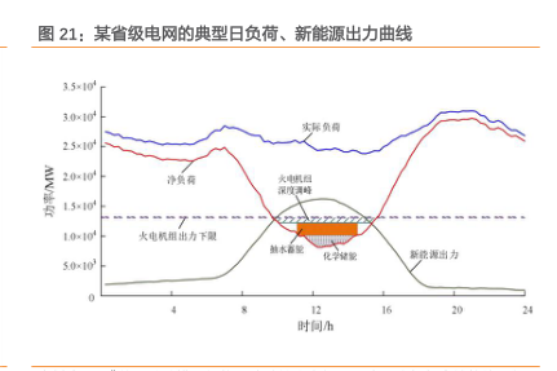
(Characteristic load curve of provincial-level power grid and new-energy power-generation output)



010-67184197、13311211762
dtly@datonglongyuan.com
Room E1-301, Oriental Plaza, No.1 East Chang' an Avenue, Dongcheng District, Beijing, China

Follow The Official WeChat Account